Books

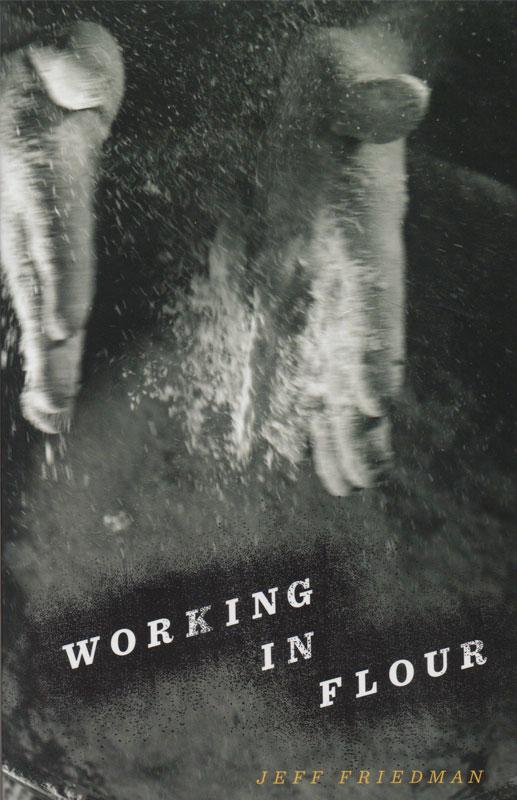
Working in Flour
88 pages paperback, $15.95
Carnegie-Mellon University Press, 2011
ISBN: 978-0-88748-533-6
Read Poems
Buy
Reviews and Comments
Jeff Friedman is a great liar and an even greater comedian. As a liar, he remembers everything and nothing from the last two thousand years. As a comedian, he knows hyperbole, pacing, irony, and all the others. He can’t fool me though, he’s a true poet and those are façades. If he had written nothing but “Poem for Ross Gay.” If he had written nothing but “My Shammai.”
—Gerald Stern
From Working in Flour’s opening poem’s comic-demotic-parodic confession of taking all the chocolate samples in a store, we know we are in the company of a poet who knows, as did Amichai, that we must laugh and cry at the same time. Jeff Friedman has written a wise and funny book, filled with bittersweet memories of a first kiss, work blunders, reconjurings of a Jewish working-class family, as well as antic surreal poems about sex. His new political and biblical poems read like small contemporary parables of mythic dimension. For its range of poems and its comic visionary American voice, Working in Flour is bloomin’ terrific!
—Sharon Dolin
Any reader who finds Working in Flour in the bookstore should start reading with poems such as “Notes from a Love Life” or “Ishmael” or “Presidential Logic” or “Bridge Street Café” or “Sotto Voce”—the spell and trance of their tone coupled with their humor will seduce you into buying this book. And buy it you should. It is marvelous.
—Ilya Kaminsky, from a review (Read full review)
How does hope survive the vicissitudes of life? Jeff Friedman’s ability to laugh and cry at the same time resonates deeply. These poems are celebratory and comic parables of fully embracing a complex, often mysterious existence, an embrace full of identification for Jewish and non-Jewish readers alike.
—Deborah Schoeneman, from a review in Jewish Book World (Read full review)

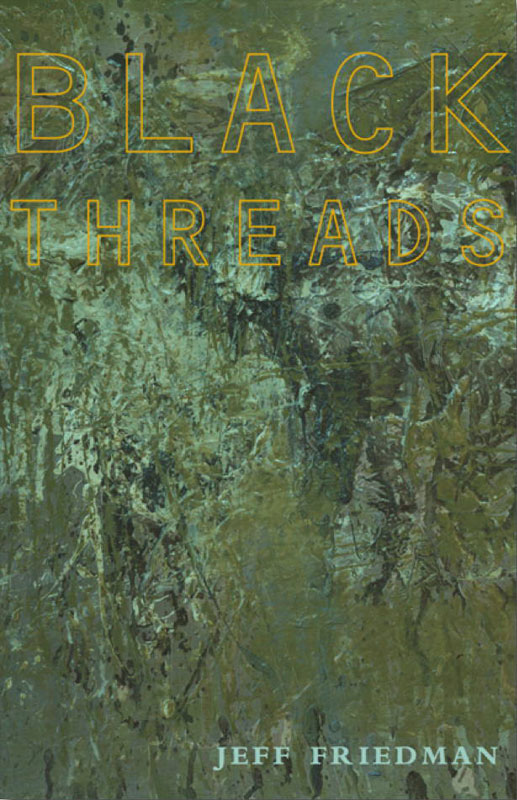
Black Threads
93 pages paperback, $14.95
Carnegie-Mellon University Press, 2007
ISBN: 0-88748-460-3; 9-780887-484605
Read Poems
Buy
Reviews and Comments
Jeff Friedman has a wide eye and keen ear, a tender touch, a nose for the absurdity of families and the fragrance of disaster, and a heart for the way everyday life melts into myth. There is an elegance and precision in these (mostly) elegiac poems, lifting them from the grit of memory, placing them on the ledge of grace.
—Alicia Ostriker
In Jeff Friedman’s narrative poems, the world of our fathers deepens into meaning. How we lived and loved and managed to flourish in 20th century America despite fear, sadness and spiritual hunger assumes Old Testament clarity. Friedman’s black threads bind Noah to the great migration, the Golem to the suburbs, and Cain and Abel to the generation that embraced rock’n’roll. Modest and wise, these poems bless both our New World domesticity and our still raging restlessness.
—Michael Waters
“It is scarcely an exaggeration to say that Jeff Friedman is a master ventriloquist and Black Threads, his fourth collection of poetry, an anthology of entwined yet disharmonic voices. Many poems in Black Threads are from the perspectives of mythic figures, family members and strays of all kinds. These poems entrust themselves to the reader like confidences whispered in a willing ear. In describing impediments impossible for people to overcome — the entropy they endure and call their lives — Friedman displays a political consciousness that takes as its subject those who live among “the alien corn” (as in the poem “Miriam”), the exiles who can’t speak the native tongue longing for home. Friedman’s poetry gives them voice.”
—Celia Bland, from a review in Valparaiso Poetry Review (Read full review)
The success of Friedman’s poetics derives from the ability of language to not merely represent but embody the stories it tells. While this implies that words are transparent to the world—a notion unpopular with linguists—this has always been the inescapable stance of poetry, endorsed by centuries of reader response. Like Ashbery and some of the other strong poets of our era, Friedman offers a model of secular redemption from the burdens of family, self, and religion through appreciation of the finely textured ecology of the material and social world.
—William Doreski, from a review in Home Planet News (Read full review)
The old stories and traditions give weight and color…to these tales of growing up and living in this modern world. They add layers of meaning and history….In a state that boasts many fine poets, Jeff Friedman distinguishes himself with old-soul voice, his ability to incorporate religious traditions without seeming particularly religious, and his amazing range.
—Rebecca Rule, from a review in The Concord Monitor (Read full review)
Black threads weave like dark music through the new poems in Jeff Friedman’s new collection, the fourth in his signature lyrical narrative mode. Readers looking for emotional nourishment will find plenty of sustenance in this collection. These are clean- lined, accessible plain-language poems; earthy, unpretentious and deeply human.
—Irene Willis, from a review in Alehouse Review
Friedman…has a scorching sense of humor and can be gleefully irreverent when dealing with his religious upbringing…but when Friedman works the litany, he is at his best, especially in dynamic poems like “Memorial” and “The Long Heat Wave.”
—Peter Makuck, from a review in the Hudson Review

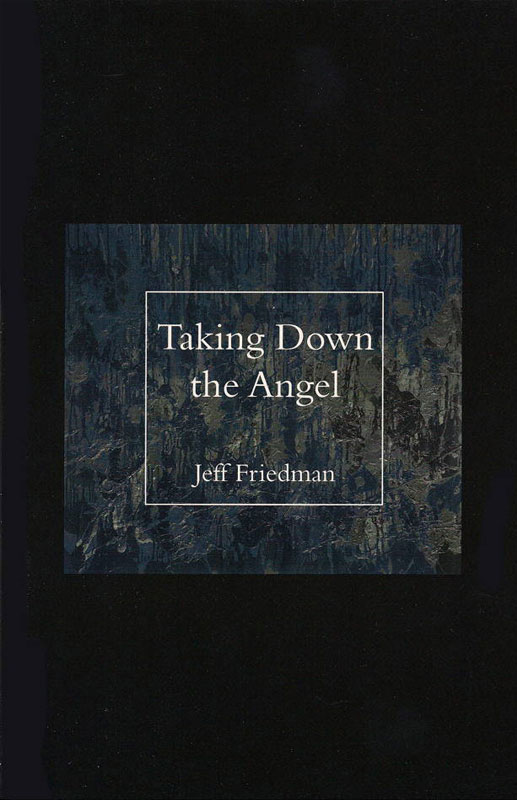
Taking Down the Angel
101 pages paperback, $12.95
Carnegie-Mellon University Press, 2003
ISBN: 0-88748-384-4; 9-780887-483844
Read Poems
Buy
Reviews and Comments
These are poems of memory; in them the past is revived in exact and painfully loving detail. We have seen and heard much of it before and it does not seem to matter; rarely has the pity of it all been so poignantly expressed, and in a style appropriately both flat and lyrical. The book holds the kind of experience you could make a movie out of, not a big box-office hit, but a satisfying small family drama and of course I mean this as praise.
—Donald Justice
There are no sleepers here. These powerful poems invite you in, pour you a cold drink, and quietly close the door behind you. For what feels like a welcomed eternity, Jeff Friedman’s voices painfully confess, lovingly describe, and, outside in the dark quiet of trees, seduce. With masterful turns of phrase and surprise, these poems leave you feeling rejoined with missing relatives and friends—and prophets who still remember how to throw a punch.
—Dzvinia Orlowsky
This book is a joy to read. Jeff Friedman’s poems are so clear and unpretentious that you’re already half way through the collection before you realize what an achievement it is. The poems of Taking Down the Angel are moving, honest, masterfully crafted, and they tell a profoundly American story.
—David Huddle
Friedman’s book is as readable as a novel, but funnier, craftier, starker, and more intelligent than all but the very best prose fiction. With a few of our other strong contemporaries, Friedman is reclaiming narrative. He is answering Robert Lowell’s call for verse with “no conflict of form and content” and “that kind of human richness in rather simple descriptive language” associated with the greatest short stories and novels, but adding to it a mythical-religious resonance less concentrated genres can’t achieve.
—William Doreski from a review in Valparaiso Poetry Review (Read full review)
As in his previous books, Record-Breaking Heat Wave and Scattering the Ashes, Friedman writes in a refreshingly straightforward style that unerringly penetrates his subjects.
—Walter Bargin, from a review in The Missouri Review
I read a lot of poetry, but I don’t read poetry like I read fiction, losing track of time, staying up late, reading entire books without pause. Taking Down the Angel, however, proved to be that startling exception. Without intending to do so. I found myself reading the final poem at the end of a single sitting. Ultimately, it is the accessibility of the poems, the intimacy of the content and the comfort of Friedman’s conversational style that makes this collection so compelling. These poems directly confront a world that inevitably exacts a toll. “Mr. Clark rose from his desk / and disappeared into the long corridor, / into the crowds of men dancing in the newsreel …” They are pieces that reflect our own questioning in the face of failure, our own longing. “How could I have prevented you / from saying what you felt / or stopped us from / growing apart?” They are filled with the realization of a stern but ultimately complex fate. “Only I, David, / greatest king of Israel, / understood his [God's] hunger / for human sacrifice, the love / in his murderous heart.” Yet there is serenity in this world of memory and yearning. “My father comes to me as a little / bit of dust swirling in the wind. / He no longer slumps when he walks / or scrapes his heels on the pavement … / He has / survived yet another Egypt / and a thousand Pharoahs.” There is a draw to these poems, an honesty in Friedman’s vision, a compassion that eschews sentimentality, a universality of loss and wonder, a familiar aching, that has marvelous appeal.
—James Beschta, Kliatt
Jeff Friedman of West Lebanon is one of New Hampshire’s best poets—if you like poems that are literary and accessible, personal and emotionally vibrant and crafted to a within a semicolon of linguistic perfection. But the language is smooth and striking and it leads in nearly every case to surprise. Not a surprise surprise or nonsequitur, but a surprise that makes the reader say, “Ahhh,” meaning: Now I see why this matters.
—Rebecca Rule, from a review in the Concord Monitor (Read full review)
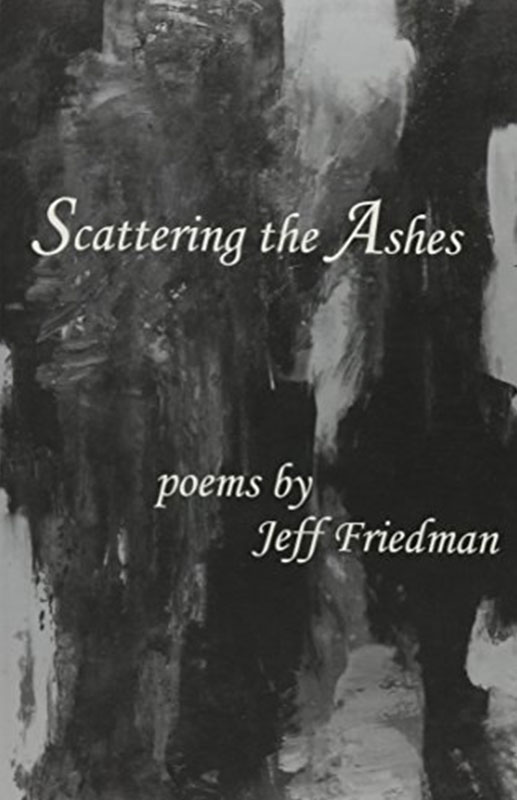
Scattering the Ashes
87 pages paperback, $11.95
Carnegie-Mellon University Press, 2003
ISBN: 0-88748-257-0; 9-780887-2571
Read Poems
Buy
Reviews and Comments
Jeff Friedman’s second book places him among the most talented younger poets writing. He is, in many of his poems, a near master of the ordinary event—plain, sharp, and intense; his gift for poignant music and fresh description issues from a respectful eye and ear held powerfully close to his subjects. You will recognize yourself in this book, and be grateful.
—Stephen Berg
Jeff Friedman’s Scattering the Ashes is a beautiful and powerful book of portraits—of factory workers and family, self and lovers. It is especially strong in its look at family relations, and the entire book builds slowly, mournfully toward its final title poem. Mr. Friedman’s work reminds me in some ways of Philip Levine—it has the same kind of crackle and exactitude, yet it manages to be very much its own creation.
—Liz Rosenberg
Jeff Friedman’s are poems of fusion; they mingle plain-song diction with meditative intensity, anecdotal harmonies with lyrical melodies, the manifold motions of dispersion with the solidifying integration of the center, wit with soul. At the end of a century of idealogy and diffraction, Scattering the Ashes is a brilliantly gracious and necessary book.
—Stephen Tapscott

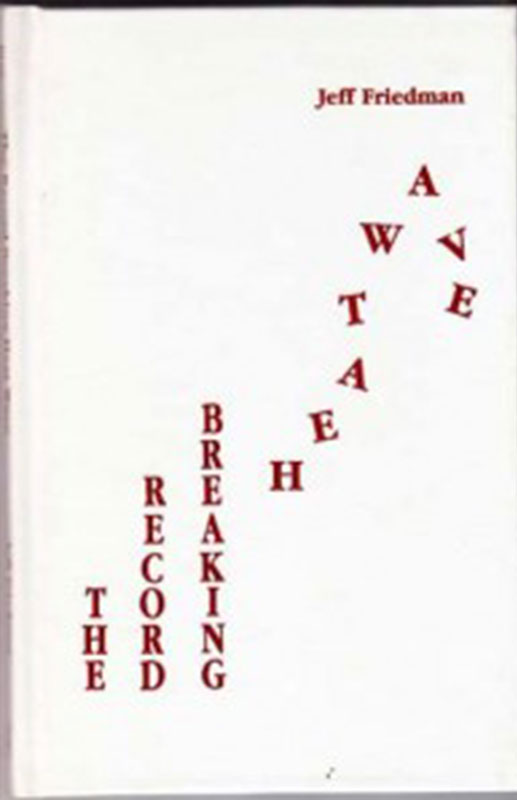
The Record Breaking Heat Wave
43 pages hardcover
BkMk Press-UMKC, 1986
ISBN: 0933532598
Buy
Reviews and Comments
This is urban poetry, working-class poetry, strongly felt, carefully observed, cleanly written. In passing, I am from time to time reminded of James Wright, but Friedman’s tone is cooler, less lapel-grabbing; nor does it seem less true.
—Don Justice
The Record Breaking Heat Wave is a technically brilliant work. It has a unity of tone which is never monotonous, and fulfills its intentions: terseness, accuracy, insight. It is the work of a first-class professional.
—Josephine Jacobsen
These poems are imbued with a fullness of life and a richness of being. Mr. Friedman articulates the timeless matters of human life, work, family, and love with compassion and comprehension. He relates his experiences with a bold exuberance and peoples his poetry with reflections of our everyday selves, not as we perceive ourselves, but as we appear to the casual observer. It is these portraiture that offer a glimpse of his talent and promise.
—D. J. Ashworth, from a review in Anemone